“Discount bonus or financial chain? In Chile, the lowest sticker price often hides the highest long-term cost.
When I landed in Chile after living in the USA, Canada, and Mexico, I thought I understood how money worked. I was wrong. In North America, if you borrow 10 million, you owe 10 million plus fixed interest. In Chile, there is a third invisible and voracious actor: the UF (Unidad de Fomento).
The UF is not a currency; it is an index that adjusts daily with inflation. This means that in Chile, your debt grows twice: once through the bank’s interest rate and again because the base value of what you owe rises every morning (currently over $39,700 CLP). After experiencing a “financial Via Crucis” firsthand, I’ve decoded the rules of the game every resident in Chile must know.
1. The New Car Trap: Dealerships as Financial Brokers
The most radical shift is understanding that car dealerships in Chile no longer just sell cars; they sell debt.
The Bonus Lure: They offer a $2,000,000 discount if you finance. It’s not a gift. It’s an upfront loan you’ll pay back with a CAE (Total Annual Cost) of up to 45%.
The Kickback Business: Salespeople prefer you to finance because the bank pays them a commission higher than the car’s profit margin. This is why paying cash is often more expensive: the system penalizes you for not wanting to go into debt.
2. The Prepayment Labyrinth: A Right, Not a Favor
If you take the loan to get the bonus and plan to pay it off immediately, expect “operational friction.” Banks hide the “Pay in Full” button and force you into slow, face-to-face paperwork.
What you need to know: By law, prepayment is an unwaivable right. The maximum penalty is only one month’s interest on the principal. Don’t let them set up artificial barriers.
3. The Danger of “Minimum Payments” and Infinite Debt
With retail cards like Líder BCI or Falabella, the minimum payment sometimes doesn’t even cover the interest. This generates interest on interest (compound interest), causing your debt to grow even if you pay every month. It’s a spiral designed to keep you paying forever.
4. The Good News: 2026 Protections
The government has implemented key changes that few are aware of:
New Minimum Payment Rules: Institutions must now ensure the minimum payment covers 100% of the interest plus a portion of the principal.
Insolvency Law (Bankruptcy): If your debt becomes unmanageable (over 90 days late), you can access a free government procedure to renegotiate at near 0% interest rates.
My Strategy: Only use Chilean credit if you can pay the “Full Statement Balance” every month. If you have foreign cards, use them to avoid UF indexation. Knowing these tools is the difference between being a hostage to the system or a savvy user.
Israel is universally believed to possess nuclear weapons, though it maintains a strict official policy of “nuclear ambiguity” or “nuclear opacity”. This means the Israeli government has never formally confirmed or denied having a nuclear arsenal.
Arsenal Size: Israel is estimated to possess approximately 90 nuclear warheads. Some older estimates have ranged higher, from 75 to as many as 400 warheads.
Nuclear Triad: It is believed Israel has a “triad” of delivery systems, meaning it can launch nuclear weapons from land, air, and sea:
Land: Jericho II and Jericho III medium-to-intercontinental ballistic missiles.
Air: Specially equipped F-15 and F-16 fighter jets.
Production Facility: Fissile material (plutonium) for these weapons is believed to be produced at the Negev Nuclear Research Center near Dimona.
Key Policy Details
The “First to Introduce” Doctrine: Israel’s standard official response is that it “will not be the first to introduce nuclear weapons into the Middle East”. It interprets “introduce” to mean publicly testing, declaring, or actually using them.
Non-Proliferation: Israel has not signed the Treaty on the Non-Proliferation of Nuclear Weapons (NPT), which allows it to avoid international inspections of its nuclear facilities.
The “Samson Option”: This term refers to a theoretical deterrent strategy where Israel would use its nuclear weapons as a “last resort” if the state’s existence were imminently threatened.
Recent regional tensions in 2024 and 2025 have occasionally brought this “secret” into the spotlight, such as when some Israeli officials made controversial “metaphorical” references to nuclear options during the conflict in Gaza.
The 1986 revelations by Mordechai Vanunu
The 1986 revelations by Mordechai Vanunu are the most significant breach in Israel’s policy of “nuclear opacity.” Vanunu, a former technician at the Negev Nuclear Research Center near Dimona, provided the first concrete evidence of a sophisticated and large-scale nuclear weapons program.
The Revelations
While working as a technician from 1977 to 1985, Vanunu became ideologically opposed to the program and secretly took 57 photographs of restricted areas, including the underground plutonium separation plant.
Publication: After leaving Israel, he shared his evidence with the British newspaper The Sunday Times, which published a landmark exposé on October 5, 1986, titled “Revealed: The secrets of Israel’s nuclear arsenal”.
Scale of the Program: Based on Vanunu’s technical data, experts concluded that Israel possessed between 100 and 200 nuclear warheads, making it the world’s sixth-largest nuclear power—far beyond previous international estimates.
The Abduction (The “Honey Trap”)
Before the article was even published, the Israeli intelligence agency Mossad launched an operation to capture him without violating British sovereignty:
Lured to Rome: An American-born Mossad agent named Cheryl Bentov (operating under the alias “Cindy”) befriended Vanunu in London and convinced him to join her for a holiday in Italy.
Kidnapping: Upon arriving in Rome on September 30, 1986, Vanunu was drugged, abducted by a Mossad team, and smuggled back to Israel on a freighter.
Communication to the Public: While being transported to an Israeli court, Vanunu famously pressed his palm against the van window; he had written details of his abduction on his hand so waiting journalists could see it.
Imprisonment and Legacy
Vanunu was convicted of treason and espionage in a secret trial and sentenced to 18 years in prison.
Solitary Confinement: He spent over 11 years in total isolation, a condition Amnesty International described as “cruel, inhuman or degrading”.
Release and Restrictions: Since his release in 2004, Vanunu has remained under strict supervision and travel bans, preventing him from leaving Israel or speaking to foreign nationals.
Impact: His revelations ended any doubt about Israel’s nuclear status, even though the government continues to maintain its official policy of “ambiguity”.
how the international community responded to these revelations at the time?
He exposed Israel’s secret nuclear weapons programme. Vanunu spent 18 years in prison, including more than 11 in solitary confinement, though no such restriction is mentioned in his sentence.
Mordechai Vanunu, el hombre que denunció el programa nuclear belico secreto de Israel hace tres décadas y acabó siendo secuestrado por el Estado de Israel.
Israel: Lift ‘ludicrous’ restrictions on whistleblower Vanunu : Amnesty International adopted him as a prisoner of conscience. He was held for years under harsh conditions in solitary confine.
The international community’s response to Mordechai Vanunu’s 1986 revelations was a mix of official silence, diplomatic maneuvering, and intense public outcry from human rights and anti-nuclear activists.
1. Official Governmental Silence and “Double Standards”
While the information was a “watershed” moment that altered global perceptions, most major world governments avoided challenging Israel directly.
The United States: Despite the evidence, the U.S. government maintained its policy of “pretending not to know” about the program. This was part of a secret 1969 understanding between President Nixon and Golda Meir where the U.S. tolerated the arsenal as long as it remained secret and untested. Critics pointed to this as a “wink and a nod” policy and a clear double standard compared to how the West treated other potential nuclear powers like Iran or Iraq.
The United Kingdom: While the revelations were published in a major British newspaper, the British government did not take diplomatic action against Israel for the kidnapping of Vanunu from Europe.
France: In the wake of the report, French officials acknowledged publicly for the first time that France had provided the initial assistance to build the Dimona reactor in the 1950s and 60s.
2. The United Nations and IAEA
The revelations triggered formal condemnation in international forums:
United Nations Resolution: In December 1986, the UN General Assembly adopted Resolution 41/93, which condemned Israel’s refusal to renounce possession of nuclear weapons and requested the International Atomic Energy Agency (IAEA) to suspend cooperation that could contribute to Israel’s nuclear capabilities.
IAEA Pressure: Arab states used the findings to lobby the IAEA to subject all of Israel’s nuclear installations to safeguards, arguing that Israel’s “rogue” status undermined the global Non-Proliferation Treaty (NPT).
3. Humanitarian and Activist Reaction
While governments remained cautious, civil society hailed Vanunu as a hero:
Whistleblower Recognition: Vanunu was awarded the Right Livelihood Award (often called the “Alternative Nobel Prize”) in 1987 for his courage.
Human Rights Campaign: Organizations like Amnesty International adopted him as a “prisoner of conscience,” focusing on the illegality of his abduction from Rome and the “barbaric” conditions of his 11-year solitary confinement.
Anti-Nuclear Movement: The Campaign for Nuclear Disarmament (CND) and other peace groups made Vanunu a global symbol of the fight against nuclear secrecy.
4. Impact on Regional Strategy
The disclosure “blew the concept of ambiguity out of the water” for experts, even if governments wouldn’t admit it. Some historians argue that Israeli leaders, including Shimon Peres, actually viewed the “leak” as a beneficial deterrent; it signaled to Arab nations that Israel had a massive nuclear backstop (the “Samson Option”) without forcing Israel to pay the political price of a public declaration.
Would you like to see a timeline of Vanunu’s legal battles since his release in 2004?
Mordechai Vanunu timeline of his legal battle against ISRAEL ?
Since his release in April 2004,
Mordechai Vanunu has remained in a state of “internal exile.” Although he completed his original 18-year sentence, the Israeli government has continuously renewed a series of restrictions that prevent him from living a normal life or leaving the country.
Timeline of Post-Release Legal Battles
April 2004: Release with Restrictions. Vanunu is released from Shikma Prison but is immediately banned from leaving Israel, entering foreign embassies, using the internet for chats, or speaking to foreign nationals and journalists without prior approval.
November 2004: First Post-Release Arrest. Only months after his release, he is arrested for allegedly violating his restrictions by giving unauthorized interviews to foreign media outlets.
2007: Second Prison Sentence. Vanunu is sentenced to six months in prison for speaking to foreigners and for a “parole violation” regarding a media interview. On appeal, the sentence is eventually reduced to three months.
May 2010: Third Imprisonment. He is returned to jail for three months after being convicted of meeting with foreigners, specifically a Norwegian woman.
2014–2015: House Arrest & Renewed Bans. In 2014, the Israeli Supreme Court upholds his travel ban despite international pressure. In 2015, he is placed under house arrest following an interview with an Israeli television channel.
2017: Community Service Conviction. He is convicted of one count of violating a legal order. The court sentences him to two months of suspended imprisonment and 120 hours of community service.
2019–2024: Continuous Renewal. Every six to twelve months, the Israeli Ministry of the Interior and security services renew his restrictions. Multiple appeals to the Supreme Court—including a bid to move to Norway to join his wife—have been consistently rejected.
2024–2025: Current Status. As of late 2024 and early 2025, Vanunu remains under strict surveillance. He continues to post monthly “Freedom” updates on social media, noting that he has been waiting for full liberation since his 1986 abduction.
The Israeli government justifies these measures by claiming Vanunu still poses a national security threat. Conversely, human rights groups like Amnesty International argue these restrictions are “arbitrary and contrary to international law,” serving only as vindictive punishment
Los Bancos Centrales han aumentado sus compras netas de oro en los últimos años como mecanismo de diversificación frente a riesgos de sanciones y dependencia excesiva del USD.
Ahora pensemos en un escenario donde el oro alcanza USD 5.000 por onza.
¿Quién se beneficia estructuralmente?
Las empresas mineras productoras.
¿Por qué?
Porque el costo de extracción no depende del precio de mercado.
Si una mina produce oro con un costo “all-in sustaining cost” (AISC) de, por ejemplo, USD 1.300–1.500 por onza:
A USD 2.000, el margen es ~USD 500–700.
A USD 5.000, el margen es ~USD 3.500–3.700.
El costo operativo no se multiplica con el precio. El margen sí.
Eso significa que el flujo de caja puede expandirse exponencialmente cuando el precio se dispara.
En términos simples:
El oro es uno de los pocos activos donde, bajo tensión sistémica, el productor puede ver expansión masiva de margen sin expansión proporcional de costos.
Para Directorios con exposición minera, esto no es especulación.
Es estructura matemática.
4️⃣ La fragmentación monetaria
Más allá del precio del oro, existe un fenómeno mayor:
Diversificación de reservas.
Comercio bilateral en monedas locales.
Reducción gradual de dependencia exclusiva del USD.
No es desdolarización total.
Es fragmentación progresiva.
En ese contexto, los activos físicos estratégicos (minerales críticos y oro) adquieren peso sistémico.
5️⃣ Propuestas concretas para Boards
Los Directorios deberían incorporar:
🔹 Stress tests geopolíticos (6–12 meses de fricción logística). 🔹 Diversificación de hubs financieros y comerciales. 🔹 Evaluación de exposición a rutas aéreas críticas. 🔹 Participación estratégica en activos reales productivos (agricultura y minería). 🔹 Comité permanente de riesgo sistémico.
La pandemia fue un recordatorio.
La tensión geopolítica actual es una advertencia.
El próximo shock no necesariamente se parecerá al anterior.
Pero volverá a poner a prueba lo mismo:
La creencia de que el sistema seguirá funcionando exactamente igual.
Y en gobernanza estratégica, la imaginación no es retórica.
In 2019, no serious board presentation included the following slide:
“Scenario: Global shutdown of economic activity and forced remote work for 12 months.”
It simply wasn’t considered realistic.
Then came COVID-19.
Entire industries stopped. Airports went silent. Offices emptied. Supply chains snapped. Governments imposed restrictions that, only weeks earlier, would have been labeled dystopian.
The pandemic was not unpredictable. Epidemiologists had warned about it for decades. What was missing was not information — it was imagination.
Most boards optimized for efficiency. Few optimized for resilience.
Now, five years later, we are watching geopolitical tensions rise again — in the Middle East, Eastern Europe, and Asia. And once more, the prevailing assumption in corporate planning seems to be:
Global trade flows will continue uninterrupted.
That assumption deserves scrutiny.
Efficiency vs. Resilience
Modern civilization is built on just-in-time logistics.
Air travel collapsed by more than 90% in some regions.
Energy markets swung violently.
And yet, infrastructure remained intact. Ports were not bombed. Sea lanes were open. Payment systems functioned.
Now imagine a different type of shock — not biological, but geopolitical.
The Difference Between a Pandemic and a War Shock
A pandemic restricts mobility and labor. A major geopolitical conflict restricts logistics and capital.
The consequences can include:
Airspace closures
Maritime insurance spikes
Sanctions and counter-sanctions
SWIFT restrictions
Energy export disruptions
Financial asset freezes
We do not need a “world war” for this to happen. Regional escalation alone can create cascading effects.
For companies dependent on global hubs — whether in energy, commodities, or finance — even temporary disruptions can produce systemic strain.
The question is not whether collapse occurs.
The question is whether planning includes sustained friction.
Have Boards Modeled These Scenarios?
Before 2020, few boards modeled:
12 months of remote work
95% revenue collapse in aviation
Global demand contraction
Coordinated government lockdowns
Today, how many boards are modeling:
Six months of restricted air corridors?
Commodity trade rerouting?
30–40% maritime insurance increases?
Payment rail fragmentation?
Regional settlement hubs becoming inaccessible?
Most strategic plans still assume continuity.
But continuity is not guaranteed.
The Lesson of the Pandemic
The pandemic taught us something deeper than epidemiology.
It taught us that:
Rare events do occur.
Interconnected systems amplify shocks.
Over-optimization reduces tolerance for disruption.
Resilience requires redundancy.
We built a global economy optimized for speed.
We underinvested in slack.
Geography Is Not Enough
It is tempting to believe that distance equals safety.
Countries far from flashpoints may avoid direct military involvement. But modern disruption is less about borders and more about networks.
Trade routes. Energy flows. Financial systems. Digital infrastructure.
A country can be geographically remote yet economically exposed.
Resilience today is not defined by mountains or oceans. It is defined by:
Energy independence
Food security
Diversified trade corridors
Institutional stability
Local production capacity
The Real Strategic Question
The right question is not:
“Will the world collapse?”
It is:
“How does our system behave under prolonged friction?”
During COVID, adaptation occurred:
Remote work scaled rapidly.
Digital commerce accelerated.
Supply chains were redesigned.
But adaptation takes time. And the initial shock is always expensive.
Boards should not be asking whether conflict will happen.
They should be asking:
What is our exposure to concentrated hubs?
How dependent are we on specific air or maritime corridors?
What happens if settlement systems fragment?
Where are our redundancy gaps?
From Optimization to Antifragility
Efficiency maximizes margins in stable conditions.
Resilience protects survival in unstable ones.
The pandemic was a reminder that tail risks are not theoretical.
Geopolitical tension is another reminder.
The companies and nations that navigate future shocks successfully will not be the ones that predicted the exact trigger. They will be the ones that invested in redundancy, flexibility, and distributed capability.
The next disruption may not look like 2020.
But it will test the same weakness: our assumption that tomorrow will resemble yesterday.
Boards that fail to ask uncomfortable “what if” questions do not fail because they lacked data.
They fail because they lacked imagination.
And imagination, in strategic governance, is not optional.
En este documento analizamos la relación entre efectivo en circulación, inflación importada, remesas, tipo de cambio y malestar social, comparando los casos de México, Estados Unidos y Chile, para finalmente concentrarse en la vulnerabilidad estructural específica de Chile: una economía exportadora de recursos naturales pero altamente dependiente de importaciones para el consumo cotidiano.
La conclusión central es clara: Chile no enfrenta un riesgo de desorden monetario, sino un riesgo de estrés social derivado de inflación importada persistente, amplificada por el tipo de cambio y por la limitada capacidad de ajuste vía expansión monetaria.
1. Marco conceptual: del dinero a la calle
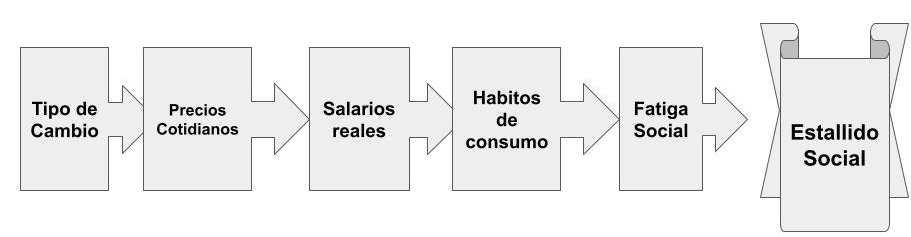
El malestar social no surge directamente de la inflación “headline”, sino de la ruptura de la previsibilidad cotidiana. El mecanismo observado es:
Este proceso explica por qué muchas protestas parecen “desconectadas” de los datos oficiales: la economía se deteriora antes de que los indicadores agregados lo reflejen.
Comparación internacional: México, Estados Unidos y Chile
México: economía dual y monetización social
Fuerte crecimiento del efectivo en circulación.
Alta correlación entre remesas y aumento de cash.
Cash crece más rápido que M2.
Lectura estructural: el efectivo actúa como válvula social.
La economía informal y la baja bancarización permiten absorber shocks sin ajuste inmediato del consumo, pero a costa de menor productividad y mayor fragilidad fiscal.
Estados Unidos: liquidez defensiva global
Crecimiento moderado del efectivo.
El dólar cumple un rol global, no doméstico.
El efectivo aumenta en contextos de incertidumbre.
Lectura estructural: el USD se fortalece incluso cuando la economía estadounidense se desacelera.
La liquidez es un activo de refugio, no un síntoma inflacionario.
Chile: disciplina monetaria, fragilidad cotidiana
Crecimiento bajo del efectivo.
Alta credibilidad del banco central.
Ajuste vía precios y salarios reales, no vía monetización.
Lectura estructural: Chile absorbe los shocks externamente (tipo de cambio) e internamente (nivel de vida).
Chile: exportador de recursos, importador de vida
Chile exporta cobre, litio y recursos naturales, pero importa una proporción creciente de bienes esenciales:
Energía y combustibles.
Alimentos procesados y proteínas básicas.
Bienes durables y electrodomésticos.
Insumos industriales y logísticos.
Hoy, entre 55% y 60% del IPC chileno depende directa o indirectamente del dólar.
El umbral crítico USD/CLP
Se identifican tres zonas sociales relevantes:
≤ 900 CLP/USD: zona funcional. Inflación manejable.
900–1.000 CLP/USD: fricción social. Caída de salarios reales.
In the 21st century, a generational shift in values, lifestyle, and emotional expectations has redefined the role of extended family, especially grandparents. Millennial parents often navigate parenthood with a strong sense of autonomy and psychological awareness, leading to both legal and emotional barriers that can separate children from their grandparents. This white paper examines how different legal systems treat grandparents’ rights, contrasts international perspectives, and analyzes the broader societal and intergenerational implications.
Comparative Legal Frameworks
A comparative analysis of grandparents’ rights in the USA, Canada, Mexico, Spain, Chile, and Japan reveals a spectrum of legal support. Countries like Spain and Chile enshrine contact rights in their civil codes, while U.S. states vary widely, and Japan offers almost no recourse.
Examples: – USA: Troxel v. Granville (2000) limits grandparent access in favor of parental rights. – Canada: Ontario’s Bill 34 amended laws to explicitly consider grandparent access. – Spain: Civil Code Article 160 ensures contact unless proven harmful. – Chile: Civil Code Article 229 supports regular contact. – Japan: Custody laws omit extended family rights.
Societal Shifts and Cultural Dynamics
Millennials are redefining family structure. The rise of therapeutic language and boundary-focused parenting has recast grandparenting from a cultural constant to an emotional variable. This shift is more pronounced in individualistic societies, where legal frameworks often reinforce the nuclear model.
Consequences include emotional loss for grandparents, developmental gaps for grandchildren, and fragmentation of cultural transmission.
Emotional and Legal Case Studies
Real-life examples show the clash between tradition and autonomy. In New York, a grandmother sued for visitation after her daughter’s death, but was denied due to lack of ‘extraordinary circumstances’. In Japan, grandparents are often entirely cut off post-divorce with no legal remedy.
These cases highlight how the erosion of traditional family roles intersects with modern legal priorities.
Conclusion and Recommendations
As the millennial generation continues to shape parenting norms, societies must find balanced ways to preserve intergenerational bonds. Legal systems should evolve to reflect the child’s right to family connection—not just the parent’s right to exclusivity. Community awareness, cultural storytelling, and respectful boundaries can together foster a more inclusive family narrative.
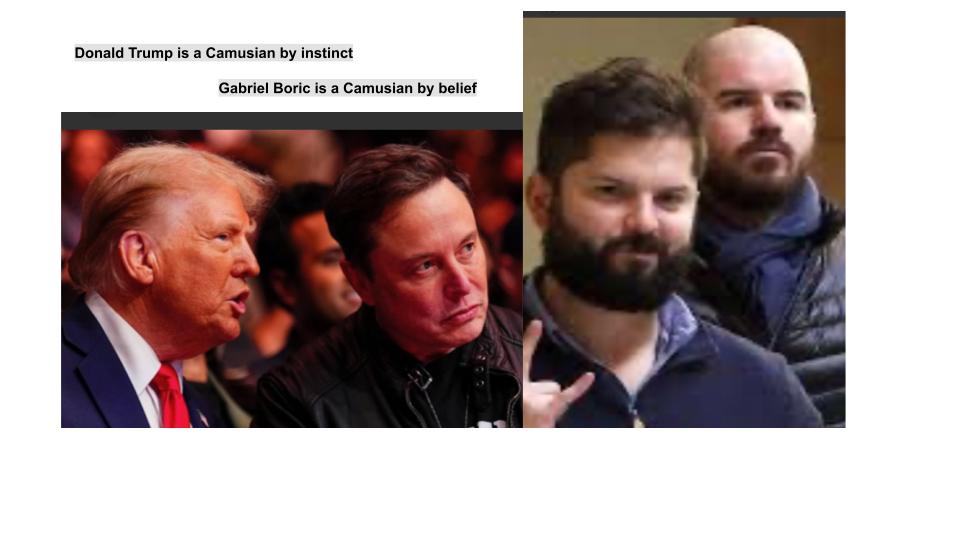
Donald Trump is a Camusian by instinctGabriel Boric is a Camusian by belief
If I were the President of a country and admired Albert Camus, it would likely be because of his commitment to moral integrity, individual freedom, and resistance against injustice. Camus’ philosophy of the Absurd—the idea that humans seek meaning in a world that provides none—might seem nihilistic, but his ultimate conclusion was one of defiant hope: that despite the absurdity of life, we must still act with courage, compassion, and honesty. As a leader, this would mean:
Why Admire Camus?
Commitment to Truth: Camus despised propaganda and refused to be a mouthpiece for ideologies, even when it cost him friendships. A President who admires him would prioritize truth over political convenience.
Resistance to Oppression: Camus was a vocal critic of both fascism and totalitarian communism. A Camus-admiring President would likely reject extremism and authoritarianism in favor of human dignity.
Pragmatic Morality: He wasn’t an idealist but believed in ethical action in a flawed world. His stance on the Algerian War—both condemning French colonialism and opposing nationalist terrorism—showed his refusal to take easy sides.
Empathy and Humanism: His works, like The Plague, emphasize human solidarity in the face of crisis—an essential quality for a leader managing a country through pandemics, war, or social upheaval.
A Rebel’s Spirit: Camus’ notion of the “rebel”—one who resists injustice but does not become an oppressor—could inspire policies that are bold but not tyrannical.
What’s the Downside?
Political Isolation: Camus refused to blindly follow ideological groups, which led to alienation from both left-wing and right-wing intellectuals. A leader like him might struggle to build strong alliances in the messy world of politics.
Pragmatism vs. Idealism Conflict: Camus’ rejection of utilitarianism (sacrificing some for the “greater good”) might make certain hard political decisions—like war, economic trade-offs, or security measures—more difficult.
The Absurd President? A leader embracing the absurd might be perceived as too philosophical and detached from practical governance. Voters and political rivals might not appreciate a leader who openly admits that life lacks inherent meaning.
Rejection of Grand Ideologies: Most political movements rely on grand narratives (progress, revolution, nationalism). Camus’ skepticism toward ideology could make it hard to rally people behind a unifying vision.
Public Perception & Criticism: Being too honest about the lack of absolute justice or meaning could alienate religious and ideological groups. Imagine a President saying, “Life is absurd, but let’s be decent anyway.” Not exactly a rousing campaign slogan.
Would It Be Crazy?
Admiring Camus as a President wouldn’t be crazy—it would be deeply principled. The real challenge would be whether a Camus-inspired leader could navigate the compromises of power without losing their moral core. Camus’ rebel spirit might make for an inspiring leader, but governing requires alliances, tough choices, and sometimes, a willingness to get your hands dirty—something he would have probably hated.
Would you vote for a Camus-style President?
Boric & Trump: Camus in the Mirror?
At first glance, Gabriel Boric and Donald Trump seem like political opposites. Boric, a leftist leader from Chile who proudly cites Albert Camus as a guiding influence, rose to power with the backing of Chile’s Communist Party. Trump, a self-styled right-wing populist, champions economic nationalism, rejects traditional elites, and publicly embraces a “strongman” persona.
But here’s where things get strange: both of them, in their own way, embody aspects of Camus’ philosophy. Boric consciously follows Camus, while Trump, perhaps unintentionally, often acts in ways that align with Camus’ vision of rebellion and absurdity.
1. The Paradox of Their Elections
Chile, historically the most economically right-wing country in Latin America, elects Boric, a former student protest leader supported by the Communist Party. The contradiction? A neoliberal stronghold chooses a self-proclaimed leftist.
The U.S., a symbol of democracy and establishment politics, elects Trump, a reality TV star and real estate mogul, who destroys traditional Republican orthodoxy and defies political norms.
Both of these elections scream revolt against the system, something very Camusian—but from different angles.
2. The Camus Connection
Camus championed the absurd rebel—someone who refuses to accept unjust systems but doesn’t become a dictator themselves. How does that apply here?
Boric: The Consciously Ethical Rebel
Boric sees himself as a moral revolutionary, fighting against inequality but still respecting democratic institutions.
He believes in solidarity, a key theme in The Plague—one that emphasizes human cooperation even in the face of existential absurdity.
His struggle? The Communist Party’s influence—can he remain a Camusian rebel while aligning with an ideological machine that demands conformity?
Trump: The Unconscious Rebel
Trump, like Camus’ absurd hero Meursault in The Stranger, rejects societal norms without remorse. He refuses to play the game, whether it’s political correctness, traditional diplomacy, or even basic decorum.
He thrives in chaos and defiance, making his leadership existential rather than ideological. He doesn’t believe in grand narratives—he simply acts.
His struggle? Power for power’s sake. Unlike Boric, he doesn’t seem concerned with the ethical implications of rebellion—his rebellion is personal, not philosophical.
3. Boric and Trump: More Alike Than Their Followers Admit
Both despise political elites and claim to represent “real people” against an entrenched system.
Both are outsiders who unexpectedly won elections, defeating establishment figures.
Both have authoritarian temptations: Boric, via his alliance with communists, and Trump, via his disregard for institutional limits.
Both struggle with governing after rebellion—Boric faces an economic crisis and institutional gridlock; Trump, during his presidency, often clashed with the system he vowed to dismantle.
4. What Does This Say About Politics Today?
Chile, a right-wing economy, votes left. The U.S., a liberal democracy, votes for an anti-establishment strongman.
Ideology matters less than existential revolt. People don’t just vote for policies anymore—they vote for rebellion against the status quo.
Camus’ idea of the rebel who resists without becoming an oppressor is hard to sustain in real-world politics. Boric tries to walk that fine line. Trump doesn’t seem to care.
5. The Downside of This Comparison
If Camus were alive, he’d likely reject both of them—Boric for allying with ideologues, and Trump for rejecting moral responsibility. But the fact that two seemingly opposite leaders reflect the same existential tensions tells us something:
Modern politics is less about left vs. right and more about rebellion vs. the establishment. Trump is a Camusian by instinct.Boric is a Camusian by belief. Both are products of a world where the old political frameworks are crumbling
Would Camus approve? Probably not. But he’d definitely write a hell of an essay about it.
The Cultural Nuances of Expressing Love in French, English, and Spanish
L’Amour, Love, Amor: The Cultural Nuances of Expressing Love in French, English, and Spanishuage is more than words; it’s a window into the soul of a culture, revealing how people perceive and express universal experiences like love. Take the phrase “L’amour, c’est une totale décomposition de la vérité” (“Love is a total deconstruction of the truth”). It’s a poetic and philosophical reflection, but its meaning shifts subtly depending on the language and the cultural context in which it’s expressed.
The French Perspective: L’Amour et la Philosophie
In French culture, love often intertwines with intellectual depth and existential musings. The original phrase, “L’amour, c’est une totale décomposition de la vérité,” reflects the French penchant for dissecting emotions with a poetic and philosophical lens. Here, love is portrayed as a force that dismantles the constructs of logic and reason—a raw, transformative experience.
For the French, this deconstruction is not a loss but a discovery. It’s the unveiling of vulnerability and authenticity, a journey through chaos to something profoundly human. The phrase invites reflection, aligning with France’s literary and artistic traditions that celebrate the complexity of love as both beautiful and challenging.
The English Perspective: Love as an Introspective Truth
In English-speaking cultures, particularly among White Anglo-Saxon Protestants (WASPs) in the United States, love is often approached with a balance of emotional vulnerability and individual introspection. The translation, “Love is a total deconstruction of the truth,” retains the idea of unraveling certainties but presents it more as a personal, internal process rather than a collective or existential one.
The tone is introspective, resonating with the Anglo-American emphasis on self-discovery and personal growth. Love, in this context, is seen as a journey where individuals confront their truths, question their beliefs, and emerge with a clearer understanding of themselves. It’s less about chaos and more about transformation within boundaries.
The Spanish Perspective: Amor y Pasión
In Latin America, love is rarely seen as a detached intellectual exercise. It’s fire, passion, and life itself. The reimagined Spanish version, “El amor es una descomposición total de la verdad, pero también una explosión de vida,” captures this spirit. Here, the deconstruction of truth is not a cold unraveling but a fiery process of surrender and rebirth.
For many Latinos, love is lived loudly and unapologetically. It’s the ultimate act of giving oneself completely, a tumultuous yet beautiful force that cannot be constrained by logic. The addition of “una explosión de vida” reflects the Latin view of love as both chaotic and affirming, a whirlwind that simultaneously consumes and uplifts.
Comparing the Three Perspectives
The differences in how this phrase is expressed and understood highlight the cultural nuances of love:
French: Intellectual, philosophical, and introspective. Love is a journey through chaos to uncover deeper truths.
English: Balanced, introspective, and self-focused. Love is about personal growth and emotional honesty.
Spanish: Passionate, intense, and life-affirming. Love is a consuming force that ignites the soul.
Each culture’s lens shapes how love is framed, showing us that while love is universal, its expression is profoundly shaped by the context in which it exists. From the poetic musings of the French to the introspective reflections of English speakers and the fiery passion of Latin America, love speaks in many tongues, each with its own unique melody.
Language shapes not only what we say but how we feel. These cultural differences remind us of the beauty in diversity and the power of words to capture the essence of one of humanity’s most profound experiences. Whether you express it as amour, love, or amor, the heart of it remains the same—a force that defies explanation yet defines us all.
What do you think? How does your culture influence the way you see and express love? Share your thoughts below! ❤️
In politics, the idea of change is one of the most compelling promises a candidate can make. Voters often yearn for something new—new policies, new ideas, and new approaches to governance. But what happens when a candidate who is part of the running government steps forward and presents themselves as the person of change? It seems paradoxical: how can someone embedded in the current system, or even a key player within it, credibly claim to be the force that will disrupt the status quo?
The answer lies in strategy, messaging, and an ability to capitalize on both insider knowledge and the hunger for reform. Here’s how these candidates often present themselves as the harbingers of change, despite their government ties.
1. Distancing Themselves from the Status Quo
A common approach for candidates from the current government is to subtly or overtly distance themselves from the existing leadership. They walk a delicate line between acknowledging the achievements of the administration they served under and pointing out its failures. They may say something like, “While we’ve made strides, there are still areas where we’ve fallen short. I am here to fix what hasn’t worked.”
By doing this, they frame themselves as reformers rather than defenders of the status quo. The message is clear: I have the experience, but I am not bound by the mistakes of my predecessors. This position allows them to simultaneously benefit from their insider status while claiming they are the fresh start the country needs.
2. Proposing New Priorities
One of the most effective ways to distance oneself from an incumbent government is to highlight new and different priorities. Even if they were part of the old system, a candidate can position themselves as an advocate for policies that were previously overlooked. They might focus on issues like corruption, climate change, or social inequality that weren’t at the forefront of the current administration’s agenda.
This shift in focus allows them to demonstrate a break with the past, suggesting that they are the best-equipped to lead the country into the future with a renewed focus on what truly matters.
3. Leveraging Insider Knowledge for Efficient Change
Unlike an outsider candidate who may lack the experience to navigate governmental red tape, a candidate who has been part of the government can claim to know the system inside out. They can argue that their knowledge of the government’s inner workings gives them an advantage in implementing swift and meaningful change.
The message is: I’ve seen what goes wrong from the inside, and that’s exactly why I know how to fix it. By portraying themselves as experienced insiders with a reformist agenda, they can blend familiarity with a promise of innovation.
4. A New Leadership Style
Sometimes, the promise of change isn’t about policies but about leadership style. Candidates in this position often argue that while the current policies may have been well-intentioned, the leadership style or strategy for implementation is outdated or ineffective.
Perhaps the current leadership is seen as too authoritarian, aloof, or opaque. A government insider can highlight how they will bring transparency, inclusivity, and modern governance techniques into play. By championing these values, they signal a change not in substance but in the approach.
For instance, emphasizing transparency, citizen engagement, and participatory governance suggests a shift towards more democratic, people-centered politics—even if the underlying policies remain largely the same.
5. Emphasizing Personal Integrity or Competence
Another key tactic is for candidates to position themselves as uniquely capable of achieving real change due to their personal traits. They can highlight their personal record within the government, focusing on integrity, results, and achievements in their previous roles. They might say, Yes, I was part of the administration, but I always pushed for reform.
By foregrounding their own clean record, competence, and reputation for getting things done, they can make the case that while the government may have faltered, they were a positive force all along, one that will now bring their vision to full fruition.
6. Building a New Coalition
Another way for government insiders to differentiate themselves from the current regime is by creating a broad coalition that includes voices from outside the administration. By aligning themselves with fresh faces—whether they are community leaders, activists, or private sector innovators—they send a clear signal that they aren’t just more of the same.
This method is particularly effective because it visually demonstrates change. A new team or coalition suggests new perspectives and ideas, helping to solidify their status as someone who will break from the past while still knowing how to navigate the system.
7. Harnessing the Idea of Continuity with Reform
A government insider can also capitalize on the idea of continuity with reform. This strategy appeals to voters who want stability but also feel that certain changes are necessary. By positioning themselves as the person who can provide continuity, they reduce the anxiety voters might feel about an entirely new administration, while still promising important reforms.
For example, they might argue that completely upending the system would cause chaos, but making targeted reforms will allow the country to move forward in a more efficient and effective way. This balance between familiarity and innovation can be compelling for voters who want change but are wary of too much disruption
Walking the Tightrope Between Experience and Innovation
In sum, a candidate from the current government can represent themselves as the person of change by carefully positioning themselves as both an insider and an outsider. They emphasize their insider knowledge while promoting a new set of priorities, leadership styles, or personal attributes that differentiate them from the current administration. By building new coalitions and promising targeted reforms rather than complete upheaval, they walk the tightrope between experience and innovation.
This nuanced approach allows these candidates to present themselves as the best of both worlds: familiar with the system, yet committed to meaningful change.
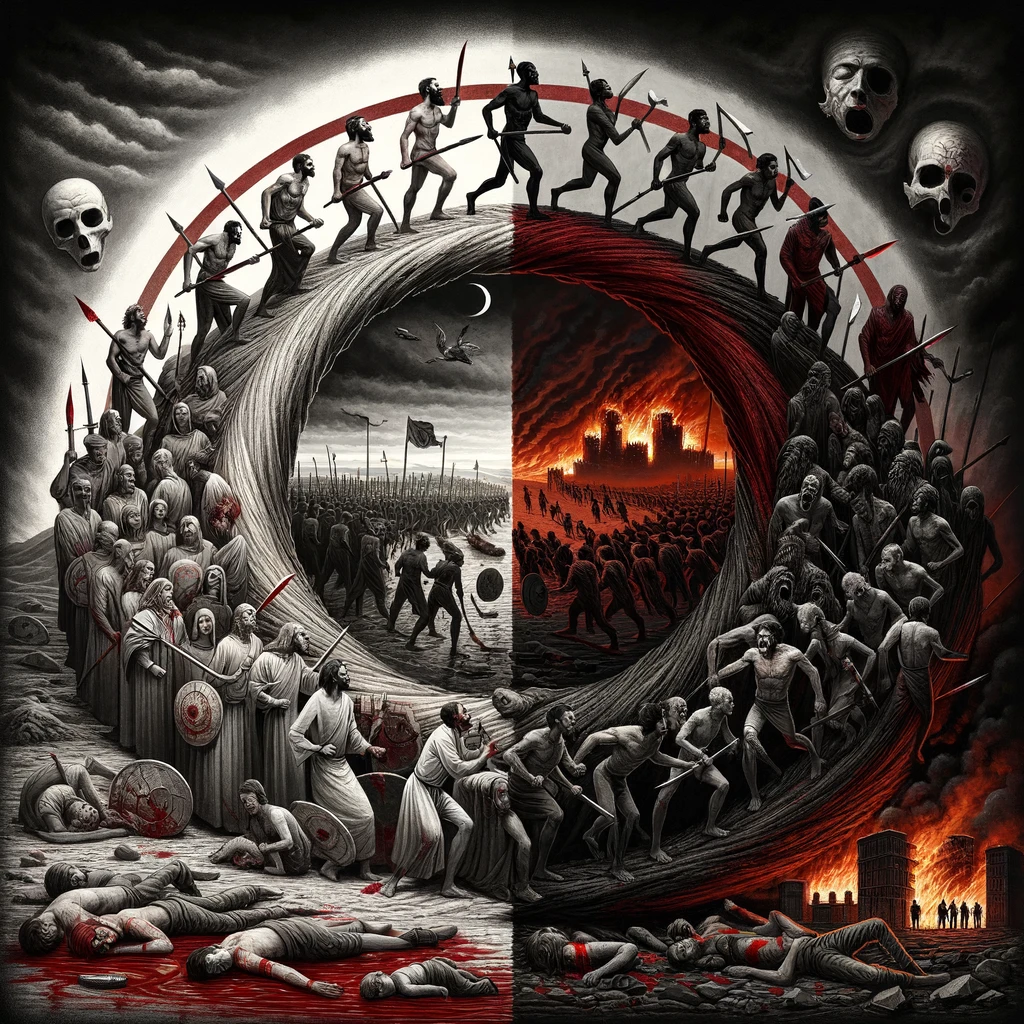
REVENGE : an eye for an eye, while primal and instinctive, often leads to destructive outcomes that reduce individuals, groups, and nations to the same level of barbarity as the original act of aggression. In seeking to right a wrong through revenge, people often perpetuate violence rather than achieving resolution or justice.
Here are some examples so we can illustrate and learn from the past how revenge manifests and how it can reduce individuals, groups, or even nations to the same level of barbarism as the original act of aggression:
1. Psychological Example: The Cycle of Abuse
In psychology, revenge is often seen as part of a vicious cycle of abuse. For instance, children who grow up in abusive households may develop deep-seated desires for revenge against their abusers. However, when these individuals act on those urges, they can perpetuate the cycle of violence, sometimes even becoming abusers themselves. This “revenge” doesn’t end the pain but instead creates new victims, often leading the person seeking vengeance to mirror the very acts they once condemned. In this way, seeking revenge can pull individuals down to the level of those who wronged them, keeping them locked in a primal, destructive loop.
2. Historical Example: The Punic Wars
A powerful historical example is the rivalry between Rome and Carthage during the Punic Wars. After Carthage was defeated in the Second Punic War, Rome exacted devastating revenge during the Third Punic War, utterly destroying the city of Carthage, killing or enslaving its people, and salting the earth to ensure it would never rise again. Rome’s relentless pursuit of vengeance brought the empire to the same level of brutality as the perceived aggressions of Carthage, illustrating how revenge can escalate to barbarism and annihilation, rather than achieving justice or peace.
3. Literary Example: “Moby Dick” by Herman Melville
In literature, revenge is often depicted as a consuming and ultimately self-destructive force. In Herman Melville’s Moby Dick, Captain Ahab’s obsession with exacting revenge on the whale that maimed him leads to his demise. His relentless pursuit of the whale draws not only himself but also his crew into destruction. Ahab’s revenge turns him into a figure as monstrous and dangerous as the whale itself, highlighting how revenge can dehumanize and drag individuals into moral darkness.
4. Political Example: The Rwandan Genocide
On a national level, the Rwandan Genocide serves as a tragic example of revenge spiraling into mass atrocity. Historical ethnic tensions between the Hutus and Tutsis erupted into one of the most horrific genocides in modern history, partly fueled by revenge for previous grievances and power struggles. The cycle of violence that unfolded shows how entire populations can be drawn into barbarism as revenge fuels hatred and retaliation. Here, seeking revenge on a mass scale led both perpetrators and victims to a level of violence and cruelty that obliterated any moral high ground.
5. Cultural Example: The Hatfields and McCoys Feud
In American folklore, the Hatfields and McCoys feud is a well-known example of revenge spiraling out of control. The conflict, which began over perceived slights and escalating acts of aggression, dragged both families into a decades-long series of retaliatory killings. The pursuit of revenge reduced both sides to lawlessness and violence, demonstrating how primitive the impulse for revenge can be when it becomes deeply embedded in cultural identity. Rather than resolving conflicts, revenge deepened the divide and perpetuated suffering on both sides.
But this are more recent examples, let’s go to the oldest ones :
These larger historical examples are powerful illustrations of how cycles of revenge, conquest, and retribution can shape entire societies over centuries. They highlight how the drive for revenge or domination can reduce nations to the same level of barbarism as their aggressors and have long-lasting, often tragic consequences.
1. The Arab Invasion of Spain (711-1492 CE)
The Arab (or Moorish) invasion of Spain in 711 CE is a classic example of a long-lasting conflict driven by conquest, retribution, and the desire for control. The Moors, who were largely Muslim, conquered large portions of the Iberian Peninsula, establishing a foothold in Europe that lasted nearly 800 years. This long period of conflict and rule came to an end with the Reconquista, a retaliatory effort by Christian Spaniards to reclaim the land. In their quest for revenge and religious purity, the Spaniards expelled or forcibly converted Muslims and Jews through brutal means, culminating in the Spanish Inquisition.
While the original act of aggression came from the Moors’ invasion, the Spanish response over centuries reflects how revenge and retribution can become national projects, reducing both sides to cycles of barbarism, forced conversions, massacres, and the eradication of cultures. The desire to reclaim Spain led to harsh persecution, which became a dark chapter in Spain’s history.
2. The Spanish Conquest of the Americas
The Spanish conquest of the Americas can be seen as an extension of this cycle of violence and revenge. After successfully driving the Moors out of Spain, Spanish conquistadors, emboldened by their religious zeal and imperial ambitions, turned to the New World. Figures like Hernán Cortés and Francisco Pizarro inflicted massive destruction on indigenous populations in their quest for wealth and power. The Spaniards replicated many of the brutal tactics used during the Reconquista in their treatment of the indigenous peoples of the Americas, including slavery, forced religious conversions, and mass killings.
The conquest of the Americas was, in some ways, Spain projecting its historical experience of subjugation and revenge onto a new context. In this case, the Spanish not only mirrored the violence they had suffered under Moorish rule but took it even further by completely eradicating entire civilizations, such as the Aztec and Inca Empires. The Spanish response to the indigenous people reflected the same ruthless drive for domination and retribution, ultimately leading to centuries of suffering and exploitation.
3. The Governor of Hispaniola and the Massacre of the Caribs
The story of the massacre of the indigenous Carib peoples under Spanish colonial rule in Hispaniola (modern-day Dominican Republic and Haiti) is another example of revenge and domination spiraling out of control. In the early years of Spanish colonization, the Carib peoples were seen as fierce and resistant to Spanish rule. The Spanish governor, in retaliation for their resistance and the threat they posed, ordered their systematic extermination. However, the massacre proved to be not only barbaric but economically costly.
In the aftermath of the decimation of the native populations, the Spanish were left with a labor shortage. This shortage led to the forced importation of enslaved Africans to work on plantations and in mines. The consequences of this cycle of violence, extermination, and slavery continue to reverberate throughout the Caribbean and the Americas today. The forced displacement of Africans set the stage for racial and social inequalities that persist across the Western Hemisphere, including the lasting impacts of racism and the legacy of colonial exploitation in North America, Central America, South America, and the Caribbean.
4. The Transatlantic Slave Trade and Its Consequences
The transatlantic slave trade, partly a result of Spain’s brutal conquest and colonization efforts, is one of the most tragic examples of how cycles of conquest and revenge can lead to barbarism on an unimaginable scale. As the European colonial powers (Spain, Portugal, Britain, and others) continued to colonize the Americas, they sought to maintain control over these vast territories by exploiting enslaved African labor. The violence inflicted on indigenous peoples by European conquerors was mirrored in the brutal treatment of African slaves.
This drive for economic dominance through the exploitation of human beings led to centuries of suffering, displacement, and social upheaval. The consequences of the transatlantic slave trade are still evident today in the systemic racial inequalities present in both the Americas and Europe. Entire societies were shaped by this cycle of violence and exploitation, creating deep divisions that remain difficult to overcome.
These historical examples reflect how cycles of revenge and domination often lead to even greater barbarism than the original acts of aggression. In seeking retribution or domination, individuals, groups, and nations frequently perpetuate cycles of violence that leave lasting scars on societies. Whether through the Arab conquest of Spain, the Spanish conquest of the Americas, or the horrific consequences of the transatlantic slave trade, the primal drive for revenge can escalate into centuries of exploitation, repression, and suffering. These legacies continue to shape modern societies, reminding us that while revenge may be primal, its consequences can be devastating and far-reaching.