
Are We Becoming Too Dependent on a Handful of Technology Giants?
By Arturo Duran | November 2026
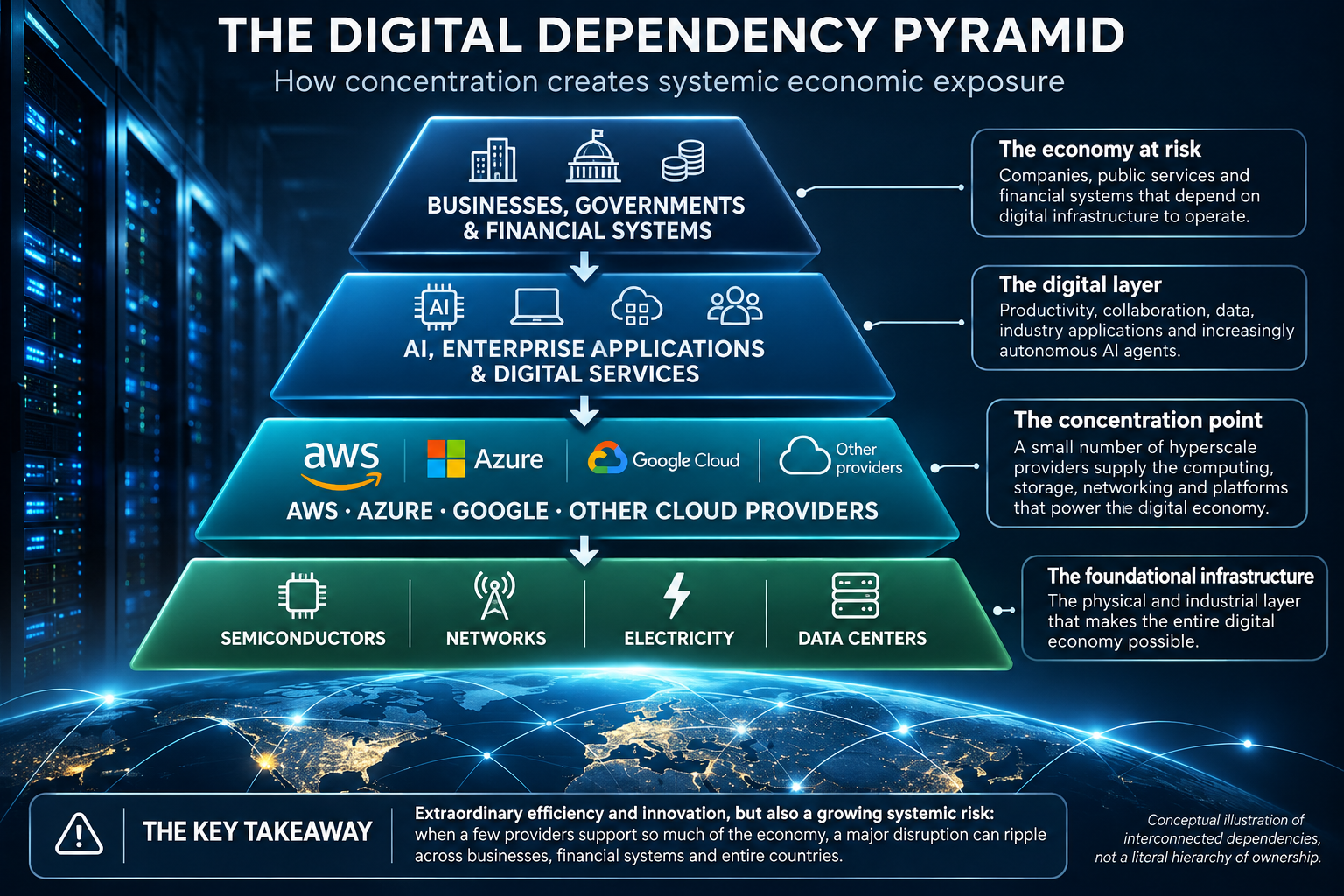
The global economy is becoming increasingly dependent on a small number of private companies that control the infrastructure powering our communications, financial systems, businesses, governments and artificial intelligence. The benefits have been extraordinary. But are we creating a new form of systemic economic risk?
Table of Contents
- The Warning Behind a Microsoft Outage
- The Concentration of the Digital Economy
- When an Outage Becomes a Systemic Economic Risk
- Five Dimensions of the Emerging Vulnerability
- Common-Mode Infrastructure Failure
- Financial Contagion
- Geopolitical Concentration
- Cybersecurity and Software Supply-Chain Vulnerabilities
- Artificial Intelligence Multiplies the Dependency
- The Difference Between Cloud Availability and Economic Resilience
- Governments and Regulators Are Beginning to Recognize the Problem
- The Investment Opportunity: Resilience as an Industry
- Why Latin America Deserves Attention
- A New Business Model: Digital Infrastructure Resilience
- What Would Happen If a Major Cloud Provider Disappeared for Seven Days?
- My Conclusion: The Next Infrastructure Revolution Will Be About Resilience
The warning behind a Microsoft outage
On November 12, 2026, Microsoft experienced a major disruption affecting services used by businesses, governments and individuals around the world.
Outlook, Exchange Online, Teams, Copilot and other Microsoft 365 services experienced widespread problems. Reports came from dozens of countries, and the disruption extended into November 13. Microsoft initially cited elevated infrastructure load, later explaining that a significant number of servers had become unexpectedly unavailable. The company reported no indication of a cyberattack, while its recovery efforts continued.
This was an important reminder of just how much of the modern economy depends on a relatively small number of technology providers.
But I believe the Microsoft incident deserves attention for a much bigger reason.
The question is not simply why a technology company experienced an outage.
The question is whether we have inadvertently created a digital economy whose critical infrastructure is too concentrated, too interconnected and too difficult to replace.
What happens when the infrastructure supporting a substantial portion of the global economy becomes unavailable, compromised, economically inaccessible or subject to geopolitical restrictions?
That is a question business leaders, investors and governments should be asking.
1. The concentration of the digital economy
Over the past two decades, businesses have moved enormous portions of their technology infrastructure from privately managed systems to cloud-based platforms.
The reasons are obvious.
Cloud computing provides scalability, flexibility, global access, lower initial capital requirements and access to sophisticated technology that would otherwise be prohibitively expensive for most organizations.
Three companies have become particularly influential in this transformation:
- Amazon Web Services (AWS)
- Microsoft Azure
- Google Cloud
According to Synergy Research Group, worldwide enterprise spending on cloud infrastructure reached approximately $168 billion in the third quarter of 2026, growing 55% year over year.
The market shares of the three largest providers were approximately:
- Amazon: 26%
- Microsoft: 19%
- Google: 16%
Together, these companies represented approximately 61% of the global cloud infrastructure market.
These numbers are impressive, but market share alone does not tell the entire story.
Consider how many different services depend on these companies.
Corporate communications, document management, financial applications, cybersecurity, databases, artificial intelligence, identity verification, logistics and increasingly automated business processes.
A company may have dozens of technology suppliers, but many of those suppliers may depend on the same underlying infrastructure.
This is where the real vulnerability begins.
We may have diversified our commercial suppliers without actually diversifying our technological dependencies.
2. When an outage becomes a systemic economic risk
In traditional financial markets, systemic risk describes a situation in which the failure or disruption of one institution or market component can spread through the system, threatening the functioning of other institutions.
The same concept increasingly applies to digital infrastructure.
Imagine a bank that uses Azure for its cloud infrastructure, Microsoft Entra for identity management, an external payment platform hosted on the same cloud, and Microsoft 365 for internal communications.
These are different services, potentially supplied under different contracts.
But they may share critical infrastructure dependencies.
If a common component fails, several business functions can become unavailable simultaneously.
This is known as a common-mode failure.
It is particularly dangerous because organizations often assume they have redundancy when, in reality, their systems share the same underlying points of failure.
The Reserve Bank of Australia addressed precisely this issue in its October 2026 Financial Stability Review.
It identified two important sources of system-level operational vulnerability:
- Concentration and lack of substitutability.
- Complex and opaque interconnections.
The central bank warned that disruptions at common service providers could spread across financial institutions, potentially impairing payments, access to funds and the ability to meet financial obligations.
Importantly, it recognized that operational risk has evolved from an individual institutional concern into a broader financial stability issue.
This is no longer just a technology management discussion.
It is an economic resilience discussion.
3. Five dimensions of the emerging vulnerability
I see five major areas where infrastructure concentration can create systemic risk.
A. Common-mode infrastructure failure
Different companies and applications may depend on the same cloud infrastructure, identity systems, networking or software components.
A failure at one shared dependency can affect organizations that otherwise appear independent.
The danger is not simply that one company loses access to its systems. It is that multiple businesses, potentially across different industries and countries, lose access simultaneously.
B. Financial contagion
Imagine a disruption affecting payment processing, banking authentication, settlement systems and financial communications.
Businesses could experience delays in paying suppliers, employees and creditors. Financial institutions could lose access to critical operational services.
A prolonged disruption, particularly during an existing period of market stress, could amplify liquidity problems and undermine confidence.
This does not mean every cloud outage will create a financial crisis. It means that operational disruptions can become financial shocks under the wrong conditions.
The Bank of England has explicitly explored this possibility in its analysis of artificial intelligence and financial stability.
It warns that widespread disruption among a small number of AI service providers could leave financial institutions unable to perform essential functions, including time-critical payments.
C. Geopolitical concentration
Digital infrastructure is global, but ownership, jurisdiction and operational control are not geographically neutral.
A company operating in Chile, Mexico, Brazil or Spain may depend on infrastructure located in another country and governed by foreign laws.
Consider the implications of:
- International sanctions.
- Export restrictions.
- Government demands for data access.
- Regional conflicts.
- Restrictions on cross-border technology services.
- Disruptions to submarine cables and telecommunications infrastructure.
Digital sovereignty is becoming an increasingly important strategic issue.
A country can enjoy political independence while remaining operationally dependent on infrastructure it does not control.
D. Cybersecurity and software supply-chain vulnerabilities
Not every major technology disruption is caused by malicious activity.
The CrowdStrike incident in July 2024 demonstrated how a defective software update could disrupt millions of Windows systems worldwide.
Other vulnerabilities include misconfigured routing, identity failures, compromised software updates, centralized management systems and human error.
The important lesson is that geographical distribution does not necessarily mean operational independence.
A thousand servers running the same defective software or controlled through the same compromised management system can still represent one common vulnerability.
E. Artificial intelligence multiplies the dependency
This is perhaps the most important emerging dimension.
AI is creating a new layer of concentration on top of the existing cloud infrastructure.
The dependency chain increasingly involves:
- Semiconductor manufacturers supplying specialized processors.
- Hyperscalers providing computing capacity, networking and data centers.
- AI laboratories developing foundation models.
- Enterprise platforms providing access to organizational data.
- Autonomous agents executing business processes and transactions.
Each layer depends on the availability and reliability of the others.
We are moving toward a world where AI agents will increasingly manage financial operations, customer relationships, procurement, logistics and internal business processes.
But what happens when those agents cannot access their computing infrastructure, identity services, databases or communications?
An autonomous business process cannot remain autonomous if its critical infrastructure disappears.
AI will increase productivity, but it will also increase the economic consequences of infrastructure failures.
4. The difference between cloud availability and economic resilience
Cloud computing is not inherently the problem.
In fact, hyperscale providers have invested enormous amounts in security, infrastructure redundancy, monitoring and disaster recovery.
For most businesses, cloud computing is substantially more secure and capable than maintaining all their technology infrastructure internally.
The problem is that availability and resilience are not the same thing.
A service can have excellent historical availability while still representing a dangerous dependency if no practical alternative exists.
Likewise, having two cloud providers does not automatically provide resilience.
If both environments depend on the same identity provider, network operator, software component or administrator credentials, a failure can affect both.
True resilience requires independent recovery capabilities.
Organizations should be asking:
- Can we operate essential business functions without our primary cloud provider?
- Can we move critical workloads to another environment?
- Do we control independent copies of our data?
- Can we authenticate users if our principal identity provider fails?
- Have we tested recovery under realistic conditions?
- Can we continue operating during a prolonged disruption?
These questions should become part of board-level risk management, not simply the responsibility of IT departments.
5. Governments and regulators are beginning to recognize the problem
This is not merely a theoretical concern.
Financial regulators are increasingly focused on technology concentration and third-party dependencies.
The European Central Bank’s 2025 supervisory work identified increasing reliance on a small number of ICT service providers, particularly cloud companies, together with low levels of substitutability and difficulties bringing outsourced services back in-house.
Its cloud outsourcing guidance under the European Digital Operational Resilience Act (DORA) is intended to strengthen financial institutions’ ability to manage these dependencies.
This is an important development.
Governments are beginning to recognize that companies providing critical digital infrastructure have characteristics similar to providers of essential economic infrastructure.
The question of whether these companies should be subject to additional resilience obligations is likely to become increasingly important.
6. The investment opportunity: resilience as an industry
Every major infrastructure transformation creates new business opportunities.
The expansion of cloud computing created enormous opportunities for data centers, networking, cybersecurity, software and infrastructure management.
I believe the next opportunity will increasingly involve making that infrastructure more independent, portable and resilient.
Rather than trying to compete directly with AWS, Azure or Google Cloud, new businesses can focus on reducing the risks created by excessive dependence on them.
I see five particularly interesting areas.
1. Edge computing and regional data centers
Processing information closer to the customer, industrial operation or government institution can reduce dependence on distant infrastructure for time-sensitive services.
2. Sovereign and hybrid cloud
Governments and businesses may increasingly seek infrastructure that provides greater control over sensitive information and critical workloads.
3. Disaster recovery and business continuity
Independent backups, alternative authentication, data recovery and continuity services can become essential business infrastructure.
4. Multi-cloud orchestration
Software that allows businesses to operate across different cloud providers, move workloads and select alternative computing resources could become increasingly valuable.
5. Distributed computing
Distributed infrastructure can provide additional capacity and resilience through multiple independent operators.
However, decentralization alone is not a guarantee of security or reliability. Governance, connectivity, power, security and operational management remain essential.
The opportunity is not simply to distribute computing.
It is to make critical services recoverable when individual providers fail.
7. Why Latin America deserves attention
I believe Latin America could become an interesting market for this next phase of infrastructure development.
Chile, Brazil and Mexico offer different opportunities.
Chile has potential in regional data centers, connectivity, renewable-energy-backed computing and specialized infrastructure services.
Brazil offers a large domestic market, an established financial technology ecosystem and growing demand for local infrastructure.
Mexico has opportunities associated with industrial nearshoring, manufacturing, enterprise technology and cross-border digital services.
There are also challenges.
Data centers require substantial capital, reliable power, transmission capacity, connectivity, cooling, water management, permitting and long-term customer commitments.
I would therefore not begin by building a large data center.
I would begin by identifying businesses and institutions that need guaranteed continuity, independent recovery capabilities and greater control over their technology dependencies.
A software-and-services model could establish a market before major physical infrastructure investments are required.
8. A new business model: Digital Infrastructure Resilience
One concept worth exploring is a regional Digital Infrastructure Resilience Network.
Its purpose would not be to replace the major cloud providers.
It would provide an independent layer of operational continuity across them.
Potential services could include:
- Independent data backup and recovery.
- Multi-cloud workload management.
- Alternative identity and authentication services.
- AI inference through alternative models and providers.
- Local computing for critical operations.
- Continuous monitoring of infrastructure dependencies.
- Disaster recovery testing and managed continuity.
Potential customers would include banks, government agencies, healthcare networks, mining companies, telecommunications operators and large enterprises.
The business model could combine recurring resilience subscriptions, infrastructure management fees, disaster recovery contracts and enterprise continuity assessments.
This is an opportunity to build a business around a problem that is becoming increasingly important to the entire digital economy.
9. What would happen if a major cloud provider disappeared for seven days?
Consider three hypothetical scenarios.
Scenario 1: A 24-hour disruption
Productivity declines, communications become unreliable, customer services are interrupted and transactions are delayed.
Scenario 2: A 72-hour disruption
Organizations begin experiencing significant operational problems. Financial institutions, logistics companies and government services may need to activate contingency procedures. Businesses with insufficient alternatives could face substantial financial losses.
Scenario 3: A seven-day disruption
The consequences could become much more serious.
Depending on the affected provider, geographic scope and dependencies, financial services, supply chains, healthcare operations and government functions could experience prolonged interruptions.
Liquidity pressures and loss of confidence could amplify the economic impact.
These are stress-test scenarios, not predictions. The consequences would vary considerably depending on which services failed and how independently organizations had prepared their infrastructure.
But one thing is clear: most businesses have not historically treated a prolonged cloud-provider disruption as a central strategic planning scenario.
That needs to change.
10. My conclusion: the next infrastructure revolution will be about resilience
The internet was originally conceived as a distributed network.
Yet much of the commercial infrastructure built on top of it has become increasingly concentrated.
We have optimized for speed, efficiency, scalability and cost.
We now need to optimize for something equally important: the ability to continue operating when critical infrastructure fails.
The Microsoft incident is a useful warning, but the issue is much larger than Microsoft.
It involves Amazon, Google, Oracle, telecommunications networks, semiconductor manufacturers, AI platforms, identity systems and the increasingly complex relationships between them.
The global economy is becoming dependent on a digital infrastructure that is essential to almost every industry.
That infrastructure deserves the same strategic attention we give to electricity, transportation, banking and telecommunications.
My strongest conclusion is that digital infrastructure resilience is becoming an economic necessity, not merely an IT expense.
I believe we are entering a new phase of technological development.
The first phase was about connecting the world.
The second was about moving the world to the cloud.
The third is about introducing artificial intelligence into nearly every business process.
The next phase may be about ensuring that all of this can continue functioning even when the infrastructure on which it depends becomes unavailable.
That is both a major economic challenge and a potentially significant investment opportunity.
And I believe Latin America should be part of that conversation.
Sources & Further Reading
The following sources provide additional research, regulatory perspectives and industry data supporting the analysis presented in this article.
1. Global Cloud Infrastructure Market
Synergy Research Group — Cloud Market Growth and Global Infrastructure Spending, Q3 2026.
2. Financial Stability and Technology Concentration
Reserve Bank of Australia — Financial Stability Review, October 2026. Focus Topic: Operational Risk and Financial Stability.
3. Artificial Intelligence and Financial System Stability
Bank of England — Financial Stability in Focus: Artificial Intelligence in the Financial System, April 2025.
https://www.bankofengland.co.uk/financial-stability-in-focus/2025/april-2025
4. Technology Outsourcing and Cloud Concentration
European Central Bank — Annual Report on Supervisory Activities 2025.
5. Digital Operational Resilience Regulation
European Union — Digital Operational Resilience Act (DORA), Regulation (EU) 2022/2554.
https://eur-lex.europa.eu/eli/reg/2022/2554/oj
6. Microsoft Service Availability
Microsoft — Official Cloud Service Status.
https://status.cloud.microsoft
7. Cybersecurity and Software Supply-Chain Risk
CrowdStrike — Global IT Outage, July 2024. Background information and incident resources.
https://www.crowdstrike.com/falcon-content-update-remediation-and-guidance-hub
8. Global Digital Infrastructure and AI Investment
International Monetary Fund — Research and analysis on AI investment, financial stability and digital infrastructure.
https://www.imf.org/en/Topics/artificial-intelligence
Note: Market statistics, incident descriptions and regulatory assessments should be checked against their original publications before republication. The November 2026 Microsoft incident was still developing when this article was prepared.
The views expressed in this article are strategic analysis and opinion. Market figures and regulatory references are attributed to the sources linked above. The November 2026 Microsoft incident was still under investigation at the time of publication.